
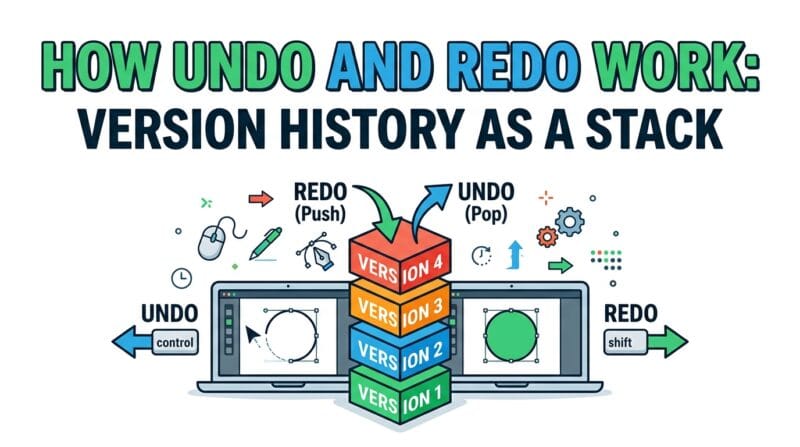
🟡 Push, pop, and why order matters
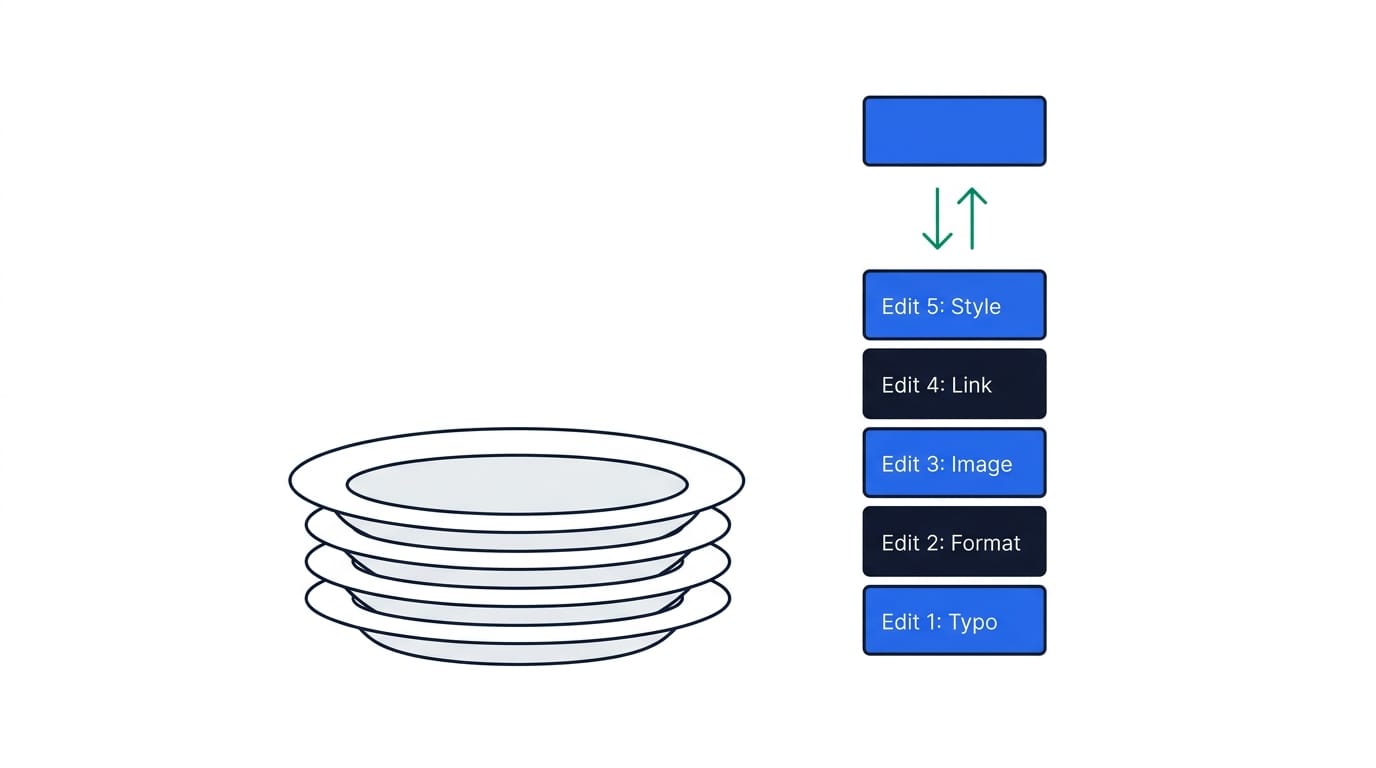
A stack supports two core operations. Push adds a new item on top. Pop removes and returns the top item. Nothing else is allowed — no reaching into the middle, no reading the bottom directly. That restriction is the whole point: it guarantees the very last change is always the very first one you get back, which is exactly the order a human expects from Undo. If changes were stored in the order they happened but read from the oldest first, pressing Undo would erase your very first edit instead of your latest one — the opposite of what anyone wants.
🟢 Multi-syllabus bridge
Stacks appear across every ICT and Computer Science syllabus that touches data structures. SL A/L ICT and Cambridge 9618 both list stacks alongside queues and linked lists, usually with push/pop questions in the written paper. AP Computer Science Principles frames the same idea more loosely, as part of how programs manage data and state while a person iterates on their work. In every case, the exam question and the Undo button in your text editor are testing the same underlying idea.
🔴 A worked example: pseudocode, then Java
Cambridge 9618-style pseudocode
DECLARE History : ARRAY OF STRING
DECLARE Top : INTEGER
Top = 0

PROCEDURE PushVersion(Text : STRING)
    Top = Top + 1
    History[Top] = Text
ENDPROCEDURE

FUNCTION PopVersion() RETURNS STRING
    DECLARE Item : STRING
    Item = History[Top]
    Top = Top - 1
    RETURN Item
ENDFUNCTION
Java
import java.util.Stack; Stackhistory = new Stack<>(); void pushVersion(String text) { history.push(text); } String popVersion() { return history.pop(); }
AI Story Script Generator
Generate a 4-act narrated script from your own instruction, then redirect any single section with your own idea and aim — never the whole script. Keeps a Story Bible for character/setting consistency, splits into sentence-safe editable parts, keeps a 3-version Undo history with Old vs New compare, and flags unsafe wording. Bring your own key (Gemini, OpenAI or Claude).
- Redirect Any Section With Your Own Aim & Idea
- 3-Version Undo + Old vs New Compare
- Sentence-Safe Parts Splitter + Import Existing Story
Both versions do the same job: push saves the version you are about to replace, pop hands back the most recent one when Undo is pressed. Many real tools cap the stack at a small number of versions instead of letting it grow forever — for example, keeping only the last three. In plain code that looks like adding to the front of a list and trimming it back to size after every push, rather than using an unlimited stack. It behaves like a stack from the user’s side (last change first), but it deliberately throws away anything older than the limit to avoid using unlimited memory.
🟡 Common mistakes
- 🔵 Popping without checking the stack is empty first — this causes a crash (or an error) the moment a user presses Undo with nothing left to undo.
- 🟠 Confusing a stack with a queue: a queue serves the oldest item first (first in, first out), which would undo your earliest edit, not your latest one.
- 🟣 Forgetting that Redo usually needs a second stack — when you undo something, the “undone” version has to go somewhere so a Redo action can bring it back.
🟢 Honest limits
- 🔵 An unlimited stack can quietly use a lot of memory in a long editing session; that is exactly why many real tools cap the history size.
- 🟠 A basic stack only tracks whole versions, not which specific words changed — a proper “diff” view needs extra logic on top.
- 🟣 Once a capped history is full, the oldest saved version is gone for good; a stack alone cannot promise infinite undo.
How the tool helps
You do not have to write any of this yourself to see it working. Every time you regenerate a section, the previous text is pushed onto that section’s own small history, capped at the last three versions, and a Restore button pops any of them straight back — the same push/pop idea from the pseudocode above, running live in your browser. You can see this exact behaviour in the AI Story Script Generator , and read more on the general idea at Wikipedia’s stack (abstract data type) page.
🔴 Frequently asked questions
What is a stack in one sentence?
A list where you can only add or remove from one end, so the last thing added is always the first thing removed.
Why not just store changes in a normal list?
You could, but a stack’s push/pop restriction guarantees the correct last-change-first order automatically, without extra logic to find the newest item.
How is Redo different from Undo?
Undo pops from a history stack. Redo needs its own second stack that stores whatever was just undone, so it can be pushed back if the user changes their mind.
Is a stack the same as a queue?
No. A stack is last-in-first-out; a queue is first-in-first-out, like a line at a shop. Undo needs a stack, not a queue.
Why do some tools only keep a few past versions?
Storing every single change forever costs memory. Capping the stack at a small number, like three or ten, keeps undo fast and memory use small.
Which exam topics does this connect to?
Stack and queue data structures in SL A/L ICT and Cambridge 9618, and program state/iteration in AP Computer Science Principles.
Leave a Reply