
Understanding the history of computing is essential to appreciate the rapid technological shifts of the modern era. Lesson 2 of the GCE A/L ICT syllabus tracks the journey from manual mechanical tools to the sophisticated electronic brains of today.
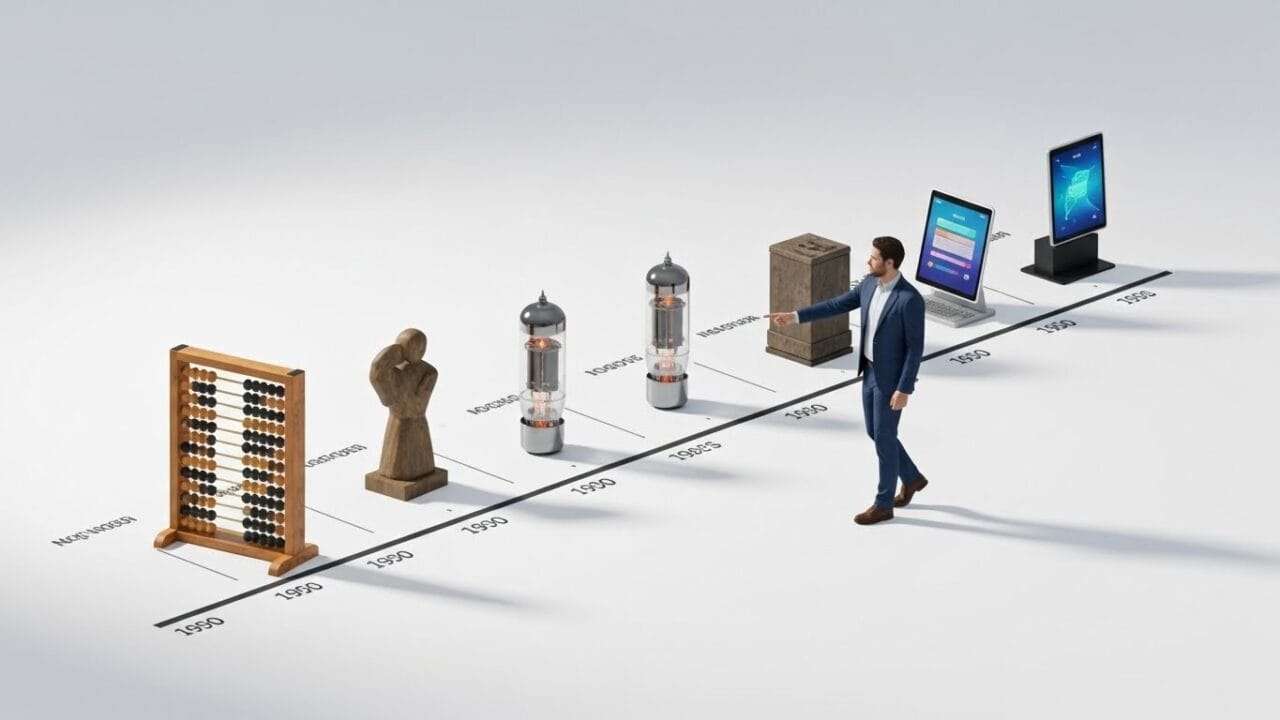
By pairing our LMS theory with the SchoolICT.net Evolution Simulator, you can witness the shrinking size and increasing power of computers over centuries.
1. The Era of Mechanical Devices
Long before electricity, humans used mechanical tools for calculation. Key milestones include:
- Abacus (approx. 3000 BC): The oldest known calculating device, used for basic arithmetic.
- Napier’s Bones (1614): Created by John Napier to simplify multiplication and division using numbered rods.
- Pascaline (1642): Blaise Pascal’s gear-based machine, the first mechanical calculator capable of addition and subtraction.
- Analytical Engine (1837): Designed by Charles Babbage (the “Father of Computing”). It was the first general-purpose computer design, featuring an “Arithmetic Logic Unit” and “Memory.”
2. The Five Generations of Electronic Computers
The electronic era is categorized by the core technology used in the circuitry of the machines.
First Generation (1940–1956): Vacuum Tubes
- Technology: Used massive vacuum tubes that generated immense heat.
- Storage: Magnetic drums.
- Input/Output: Punched cards and paper tape.
- Example: ENIAC, UNIVAC.
Second Generation (1956–1963): Transistors
- Technology: Transistors replaced vacuum tubes, making computers smaller, faster, and more energy-efficient.
- Language: Introduction of COBOL and FORTRAN.
- Example: IBM 7094.
Third Generation (1964–1971): Integrated Circuits (IC)
- Technology: Hundreds of transistors were placed on a single silicon chip (IC).
- Innovation: Users interacted via keyboards and monitors instead of punched cards.
- Example: IBM 360 series.
Fourth Generation (1971–Present): Microprocessors
- Technology: Thousands of ICs were built onto a single silicon chip (VLSI – Very Large Scale Integration).
- Impact: This led to the birth of the Personal Computer (PC) and the Internet.
- Example: Apple II, Altair 8800.
Fifth Generation (Present & Beyond): Artificial Intelligence (AI)
- Technology: Focuses on Parallel Processing and ULSI (Ultra Large Scale Integration).
- Goal: Devices that can understand natural language and self-organize.
- Example: Robotics, Voice recognition (Siri/Alexa), Quantum computing.
3. Comparison of Computer Generations
| Generation | Main Component | Size | Speed | Programming Language |
| 1st | Vacuum Tubes | Room-sized | Very Slow | Machine Language |
| 2nd | Transistors | Large Cabinet | Slow | Assembly Language |
| 3rd | ICs | Desktop | Fast | High-Level (Pascal/C) |
| 4th | Microprocessors | Handheld/Laptop | Very Fast | 4GL (SQL/Python) |
| 5th | AI/Biochips | Nano-scale | Ultra Fast | Natural Language |
Export to Sheets
4. Interactive Learning: Evolution Tool
The SchoolICT.net Evolution Tool allows you to interact with history through several digital modules:
Features of the Tool:
- Timeline Drag-and-Drop: Match the device (like the Pascaline or ENIAC) to its correct century or generation.
- Component Switcher: Click through the generations to see a 360-degree view of a Vacuum Tube vs. a modern Microprocessor.
- Logic Quiz: Test your knowledge on which generation introduced the first Operating System or the first Mouse.
- Comparison Lab: Drag different devices into a “Comparison Zone” to see how their power consumption and processing speeds differ.
5. Key Personalities in Computing History
- Charles Babbage: Designed the Difference Engine and Analytical Engine.
- Ada Lovelace: The first computer programmer (wrote algorithms for Babbage’s machine).
- Alan Turing: Founder of modern computer science and AI.
- John von Neumann: Developed the stored-program concept (Von Neumann Architecture).
6. Exam Success Tips for A/L Students
- Technological Milestone: Be clear on which component defined which generation (e.g., IC for 3rd Gen).
- Trend Observation: When describing the evolution, focus on four trends: Decreasing Size, Decreasing Cost, Increasing Speed, and Increasing Reliability.
- Ada Lovelace: Don’t forget her contribution! She is often a target for multiple-choice questions regarding early programming.
- VLSI vs. ULSI: Remember that the 4th Generation uses VLSI, while the 5th Generation uses ULSI.
Conclusion: Bridging the Past and the Future
From the wooden beads of the Abacus to the neural networks of AI, the evolution of computing is a testament to human ingenuity. Mastering Lesson 2 helps you understand that the smartphone in your pocket is the result of centuries of mathematical and physical breakthroughs.
Explore the history of technology:


Leave a Reply