
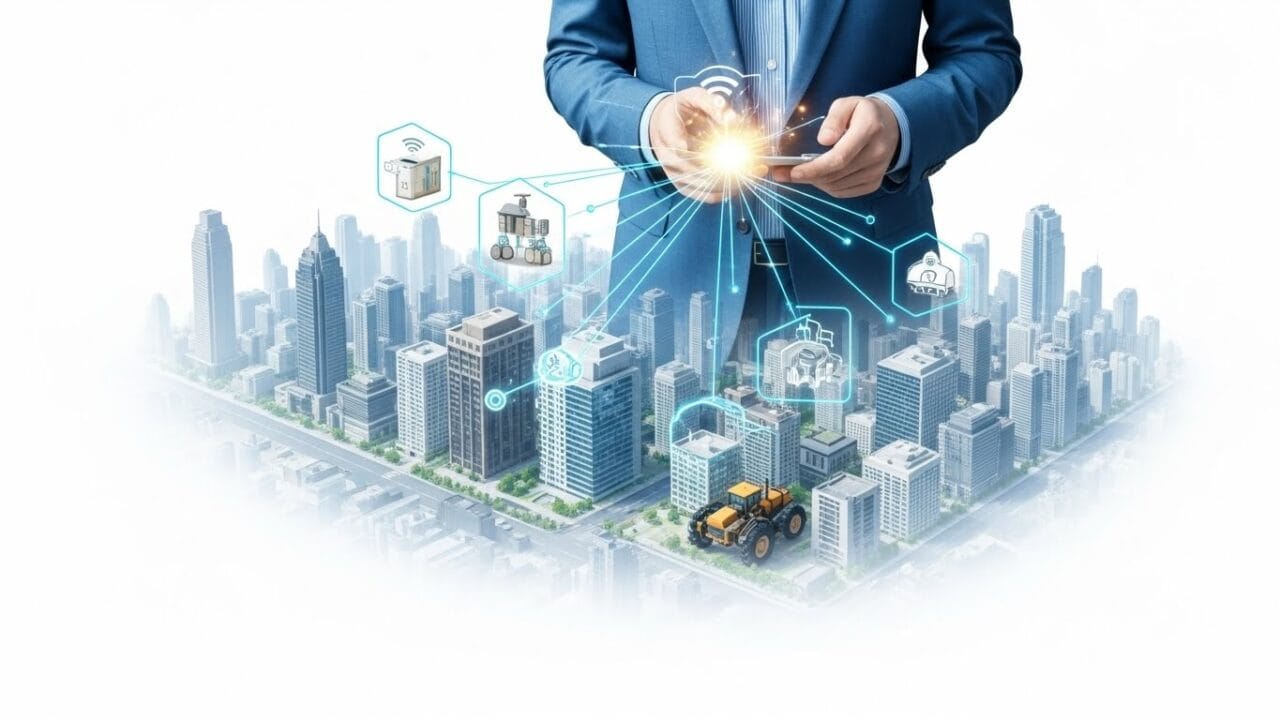
The Internet of Things (IoT) represents the next evolution of the internet, where everyday objects are embedded with sensors and software to collect and exchange data. For GCE A/L ICT students, Lesson 11 explores how physical devices transition into “smart” devices to improve efficiency in homes, hospitals, and industries.
By combining the theory from our LMS with the SchoolICT.net IoT Learning Tool, you can visualize how sensor data triggers real-world actions.
1. What is the Internet of Things (IoT)?
IoT refers to a network of physical objects (“things”) that are embedded with sensors, software, and other technologies for the purpose of connecting and exchanging data with other devices and systems over the internet.
Basic Components of an IoT System:
- Sensors/Devices: The “eyes and ears” that collect data from the environment.
- Connectivity: How data reaches the cloud (Wi-Fi, Bluetooth, Cellular, Satellite).
- Data Processing: Analyzing the data (often via a microcontroller or cloud server).
- User Interface: How the user interacts with the system (Mobile app or web dashboard).
2. Sensors and Actuators
In the A/L syllabus, it is crucial to distinguish between these two components:
- Sensors: Input devices that detect changes in the physical environment.
- Examples: Temperature sensor, Humidity sensor, PIR (Motion) sensor, Light (LDR) sensor.
- Actuators: Output devices that perform an action based on the sensor data.
- Examples: Electric motors, LED lights, Buzzers, Relays (to turn on high-voltage appliances).
3. The Role of Microcontrollers
A microcontroller acts as the “brain” of an IoT device. It receives inputs from sensors, processes the logic, and sends commands to actuators.
- Popular Examples: Arduino, Raspberry Pi, ESP32 (which has built-in Wi-Fi and Bluetooth).
4. Common IoT Application Areas
IoT is transforming every sector of the Sri Lankan economy:
- Smart Agriculture: Sensors monitor soil moisture and automatically trigger irrigation systems.
- Smart Home: Controlling lights, ACs, and security cameras remotely via a smartphone.
- Smart Health: Wearable devices that monitor heart rate and alert doctors in emergencies.
- Smart Industry (Industry 4.0): Machines that predict when they need maintenance to prevent breakdowns.
5. IoT Architecture and Protocols
To communicate effectively, IoT devices use specific protocols designed for low power and high efficiency:
- MQTT (Message Queuing Telemetry Transport): A lightweight messaging protocol perfect for remote sensors with low bandwidth.
- CoAP (Constrained Application Protocol): A specialized web transfer protocol for use with constrained nodes.
6. Interactive Learning: IoT Application Tool
Building physical IoT circuits can be expensive. The SchoolICT.net IoT Learning Tool provides a virtual sandbox to experiment with logic.
Features of the Tool:
- Virtual Circuit Builder: Drag and drop sensors (like an LDR) and actuators (like an LED) onto a virtual breadboard.
- Logic Simulator: Set conditions (e.g., “If Light Intensity < 500, then Turn on LED") and watch the system react in real-time.
- Data Visualizer: See a live graph of sensor data to understand how “Big Data” is generated by IoT devices.
- Scenario Challenges: Solve real-world problems, such as designing a “Smart Street Light” or an “Automated Greenhouse.”
7. Challenges and Risks of IoT
While powerful, IoT brings new concerns:
- Security: Every connected device is a potential entry point for hackers.
- Privacy: Constant data collection can lead to the exposure of personal habits.
- Interoperability: Different brands of devices often struggle to “talk” to each other.
- Electronic Waste (e-Waste): The rapid replacement of smart devices harms the environment.
8. Exam Success Tips for A/L Students
- Input vs. Output: Always identify if a device is a Sensor (Input) or an Actuator (Output).
- Define the Network: Remember that for it to be “IoT,” the device must be connected to a network to share data; a simple automatic light without internet is just an electronic circuit.
- Real-World Examples: Be ready to describe a complete IoT scenario (Sensor → Processor → Connectivity → Actuator) for a specific field like healthcare or transport.
- MQTT and Low Power: Know that MQTT is the preferred protocol for IoT because it consumes very little power and data.
Conclusion: Shaping a Connected Future
Lesson 11 is where ICT meets the physical world. Understanding IoT prepares you for a future where technology is woven into the very fabric of our lives. Use our LMS notes to study the components and our interactive simulator to design your first smart system.
Ready to build your first smart device?



Leave a Reply