
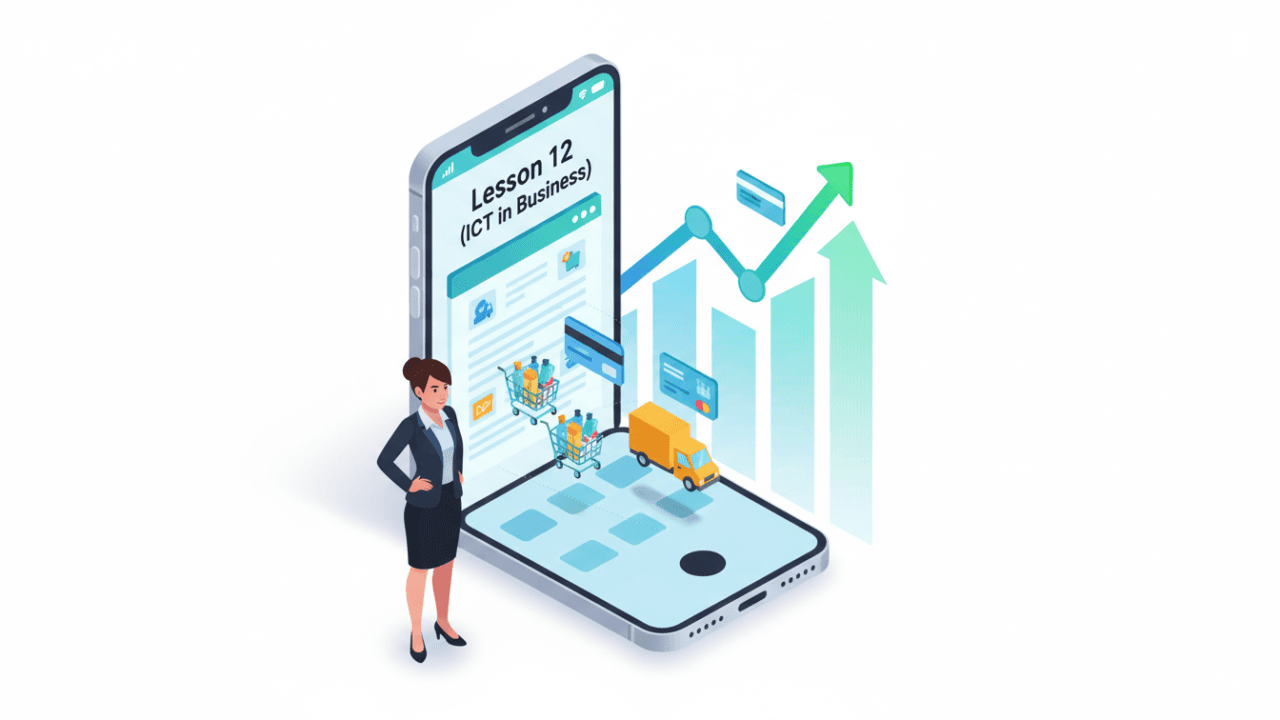
The integration of Information Technology into the business world has completely redefined how products are created, marketed, and sold. For GCE A/L ICT students, Lesson 12 explores the digital economy, focusing on e-Commerce, e-Business models, and the technologies that facilitate global trade.
By combining the theory from our LMS with the SchoolICT.net ICT in Business Tool, you can simulate the operations of a modern digital storefront.
1. e-Business vs. e-Commerce
While often used interchangeably, there is a technical difference that A/L students must understand:
- e-Commerce (Electronic Commerce): Specifically refers to the buying and selling of goods and services over the internet.
- e-Business (Electronic Business): A broader term that includes e-commerce but also covers internal business processes such as supply chain management, electronic order processing, and customer relationship management.
2. e-Commerce Business Models
Businesses are categorized based on who is selling and who is buying:
| Model | Full Name | Description | Example |
| B2C | Business to Consumer | A business sells directly to an individual. | Amazon, Kapruka |
| B2B | Business to Business | Businesses trade with each other (wholesale). | Alibaba, Intel selling to Dell |
| C2C | Consumer to Consumer | Individuals sell to other individuals. | eBay, Ikman.lk |
| C2B | Consumer to Business | Individuals offer services/products to firms. | Freelancers on Fiverr |
| G2C/B | Govt to Citizen/Bus. | Government providing digital services. | e-Revenue license, Tax portals |
3. Electronic Payment Systems (EPS)
For e-commerce to function, there must be a way to transfer money securely online.
- Credit/Debit Cards: The most common method using payment gateways.
- Electronic Wallets (e-Wallets): Digital versions of physical wallets (e.g., PayPal, Apple Pay, eZ Cash).
- Electronic Funds Transfer (EFT): Direct transfer of money from one bank account to another.
- Digital Currency: Cryptocurrencies like Bitcoin that operate on blockchain technology.
4. Modern Business Technologies
- ERP (Enterprise Resource Planning): Software that integrates all departments of a company (Finance, HR, Sales) into one system.
- CRM (Customer Relationship Management): Tools used to manage a company’s interaction with current and potential customers.
- Business Intelligence (BI): Using data mining and analytics to make better business decisions.
5. Advantages and Challenges of e-Business
Advantages:
- 24/7 Availability: Businesses never close.
- Global Reach: A small shop in Sri Lanka can sell to a buyer in London.
- Cost Reduction: No need for expensive physical showrooms for every location.
Challenges:
- Security: Risks of hacking and credit card fraud.
- Privacy: Misuse of customer personal data.
- Digital Divide: People without internet access are excluded from the digital economy.
6. Interactive Learning: ICT in Business Tool
Understanding business logic is easier when you see the data flow. The SchoolICT.net ICT in Business Tool offers a practical simulation.
Features of the Tool:
- Business Model Classifier: Face various scenarios (e.g., “A student sells an old phone to a neighbor via a website”) and identify the correct model (C2C).
- Payment Gateway Simulator: Visualize the steps of an online transaction, from the “Checkout” button to the “Bank Verification” and “Merchant Confirmation.”
- E-Commerce Store Builder: Drag and drop elements to create a landing page and learn how product catalogs are linked to databases.
- Revenue Calculator: Practice calculating “Profit Margins” and “Conversion Rates” using mock business data.
7. The Impact of AI and Big Data in Business
Businesses today collect massive amounts of data to understand consumer behavior.
- Recommendation Engines: “Customers who bought this also bought…”
- Dynamic Pricing: Prices change based on demand (common in airline tickets).
- Chatbots: AI-powered customer service agents available 24/7.
8. Exam Success Tips for A/L Students
- Model Identification: In MCQ papers, be very careful with C2B vs. B2C. If the individual is providing the value (like a photographer selling a photo to a magazine), it is C2B.
- Payment Security: Understand the role of SSL/TLS (the padlock in the browser) in securing business transactions.
- EDI (Electronic Data Interchange): Remember that EDI is the computer-to-computer exchange of business documents in a standard electronic format.
- Brick and Click: Know that “Brick and Click” refers to businesses that have both a physical store and an online presence.
Conclusion: Navigating the Digital Economy
Lesson 12 prepares you for the professional world, whether you intend to start your own startup or join a global corporation. ICT in Business is not just about technology; it’s about using technology to create value and efficiency. Use our LMS notes to master the concepts and the interactive tool to simulate your business success.
Ready to start your digital business?



Leave a Reply