
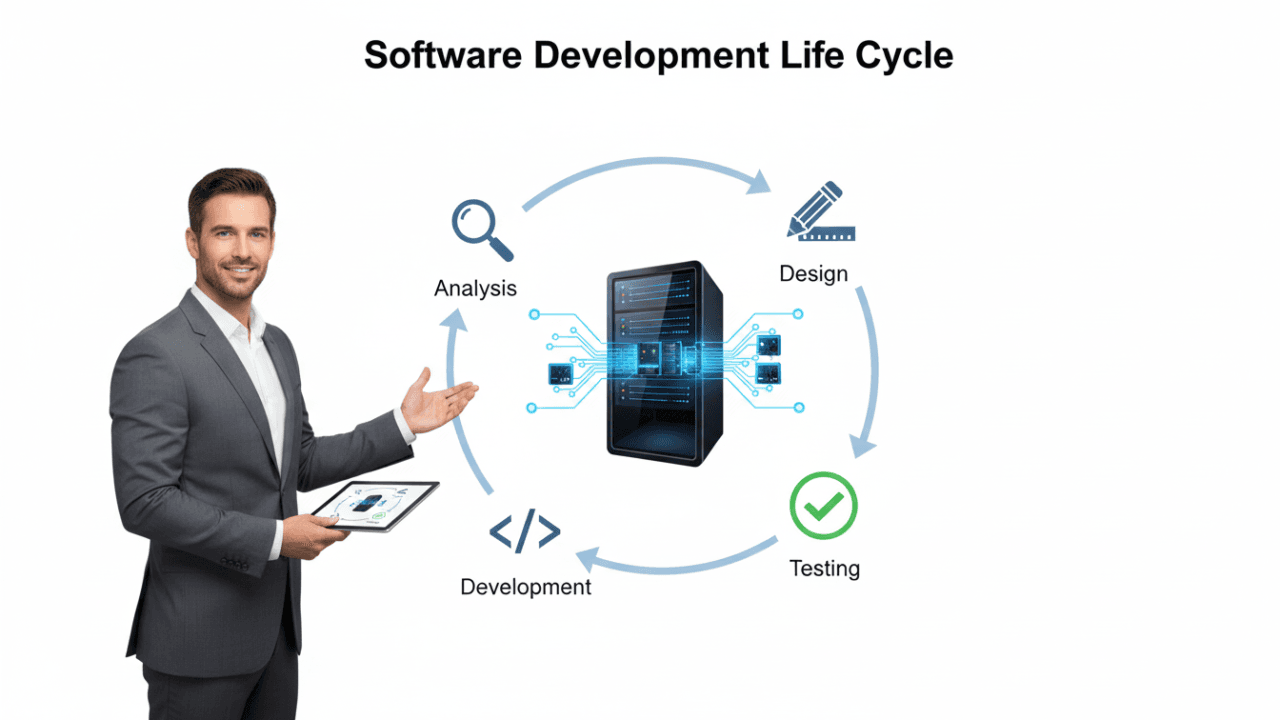
Developing a high-quality information system is not a random process; it requires a structured approach known as the System Development Life Cycle (SDLC). For GCE O/L ICT students, Lesson 11 provides the blueprint for how software and systems are conceived, built, and maintained in the real world.
By utilizing the SchoolICT.net interactive learning tool, you can visualize the flow of a system from a simple idea to a fully functional application.
1. What is the System Development Life Cycle (SDLC)?
The SDLC is a step-by-step process used by system analysts and developers to design, develop, and test high-quality systems. The primary goal is to meet user requirements while staying within budget and time constraints.
The most common model taught in the O/L syllabus is the Waterfall Model, where each phase must be completed before the next one begins.
2. The 7 Phases of SDLC
Every student must memorize these stages in order, as they frequently appear in Paper I and Paper II.
A. Identification of Requirements
The starting point where the need for a new system is identified. Analysts look at the problems in the current system and define the goals for the new one.
B. Feasibility Study
Determining if the project is “doable.” Analysts check:
- Technical Feasibility: Do we have the technology?
- Economic Feasibility: Do we have the budget?
- Operational Feasibility: Will people actually use it?
C. System Analysis
Deeply understanding the current process. Common methods for gathering data include interviews, questionnaires, observations, and document reviews.
D. System Design
Creating the “blueprints.” This includes designing the user interface (UI), database structure, and flowcharts.
- Logical Design: How data flows.
- Physical Design: Actual hardware and software specifications.
E. System Development (Coding)
The stage where programmers write the actual code (using languages like Pascal, Python, or Java) and set up the databases.
F. System Testing
Before the system goes live, it must be checked for bugs.
- Unit Testing: Testing individual parts.
- Integrated Testing: Testing the system as a whole.
- User Acceptance Testing (UAT): Ensuring it meets the user’s needs.
G. Deployment and Maintenance
The system is installed for the user. Maintenance involves fixing new bugs and updating the system to meet changing needs over time.
3. System Deployment Methods
How do you switch from an old system to a new one? There are four main ways:
- Direct Deployment: Switch off the old, switch on the new immediately. (Risky!)
- Parallel Deployment: Run both systems side-by-side for a while. (Safest.)
- Pilot Deployment: Test the new system in only one department first.
- Phased Deployment: Introduce the new system in stages.
4. Interactive Learning: SDLC Simulator
System development can feel abstract until you see it in action. The SchoolICT.net SDLC Learning Tool is designed to make these phases tangible.
Features of the Tool:
- Phase Drag-and-Drop: Practice arranging the stages of the Waterfall model in the correct sequence.
- Data Gathering Matcher: Match specific scenarios to the best data gathering method (e.g., “Gathering data from 500 students” → “Questionnaire”).
- Testing Lab: Simulate a testing environment where you identify errors in a mock system.
- Deployment Visualizer: See a step-by-step animation of how Parallel vs. Direct deployment works in a business environment.
5. Exam Success Tips for O/L Students
- Identify the Stage: In the exam, you might get a scenario (e.g., “A programmer is writing code”) and be asked which stage it belongs to.
- Gathering Data: Remember that Interviews are best for detailed info from a few people, while Questionnaires are best for gathering general info from many people.
- The “V” Model: Be aware that while the Waterfall model is common, the syllabus occasionally mentions that testing should happen at every stage, not just at the end.
- Maintenance is Constant: A system is never “finished.” Maintenance is the longest phase of the SDLC.
Conclusion: Building the Future
Understanding the SDLC is like learning the grammar of technology. It ensures that systems are built to last and serve people effectively. By combining the detailed notes from our LMS with the interactive simulator, you will be well-prepared to tackle any system development question in your O/L examination.
Ready to build your knowledge?




Leave a Reply